A Monday digest of BIS notices whose titles match your HTS codes.
The $29 Watchlist emails a digest every Monday at 09:00 UTC. That email is the weekly digest, not a same-day alert.
Section 232 derivative coverage is not a one-time event: new Commerce/USTR notices under Proclamation 11021 can propose additional HTSUS subheadings, on no fixed schedule. The watchlist ($29/mo) matches your codes against the titles of Bureau of Industry and Security Federal Register notices and emails a digest every Monday at 09:00 UTC — the last 7 days, with comment deadlines flagged. Not a same-day alert. Free 60-second exposure check to start.
Last Section 232 derivative-article proposal (FR 2026-15961): 66 days ago. Since Proclamation 11021 ended the petition-based inclusion process on April 6, 2026, new derivative notices from Commerce and USTR follow no fixed schedule — the watchlist's Monday digest flags any whose titles match your HTS codes (titles only, so a notice can be missed).
See the full U.S. trade regulatory calendar — every upcoming BIS, USTR, CBP, and Commerce deadline for the next 90-plus days, with primary-source citations to Federal Register, USTR, CBP, and Commerce.
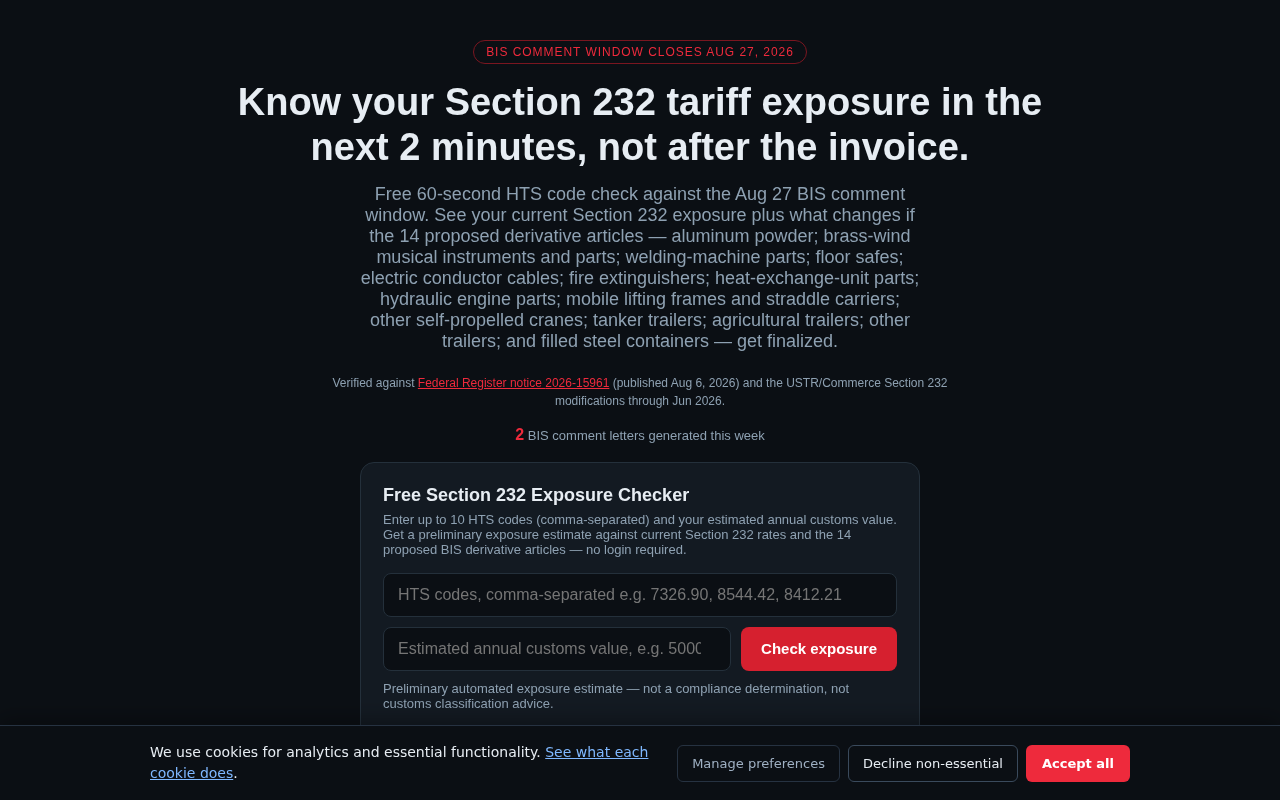
Verified against Federal Register notice 2026-15961 (published Aug 6, 2026) and the USTR/Commerce Section 232 modifications through Jun 2026.
What you do: after checkout you enter up to 20 HTSUS subheadings — the codes you actually import under.
What we watch: Bureau of Industry and Security Federal Register notices against those codes. The paid email is not a USTR, CBP, or Commerce alert feed.
What triggers an email: every Monday at 09:00 UTC, a digest of the last 7 days of those BIS notices whose titles match your codes — including on a quiet week, so you can tell “nothing happened” from “the monitor died.” It is not a same-day alert.
Why it is worth $29: the alternative is someone on your team re-reading the Federal Register every morning, or finding out when a broker calls about a held container.
Cancel any time at /account. Separately: the Aug 27, 2026 BIS comment window has closed, so the $99 rebuttal-filing service is not purchasable — we don't take payment for a filing we cannot submit.
Try the checker below → no signup, no email
- Who
- TariffWatch is the Section 232 HTS exposure tool from Digital Empire Holdings LLC (30 N Gould St Ste N, Sheridan WY 82801), built by Andy Gaber. It is for importers and trade-ops people who already have HTS codes in front of them. We are not CBP, not BIS, not Commerce, and not a licensed customs broker under 19 CFR 111.
- How the free check works
- Paste up to 10 HTS codes and your annual customs value into the checker on this page. A deterministic engine returns a heading-level Section 232 exposure estimate against the derivative-article categories proposed in Federal Register 2026-15961. Same inputs in, same findings out. No signup, no email, no LLM call.
- Why you might keep watching after that
- The free check is a one-shot snapshot. Section 232 derivative coverage can expand with any new Commerce/USTR notice (no fixed schedule), so the answer can change after you close this tab. Watchlist at $29/mo is the keep-watching option — it does not unlock a better answer today. The 2026-15961 comment window closed Aug 27, 2026 and we do not reopen it.

Loading exposure checker…
Who — Digital Empire / TariffWatch
TariffWatch is a Section 232 exposure-estimate and public-notice monitoring tool from Digital Empire Holdings LLC (30 N Gould St Ste N, Sheridan WY 82801), built by Andy Gaber. The people who use it are SMB importers, in-house trade and compliance ops, and the occasional broker double-checking a derivative-article question. Support is a human at support@tariffwatch.app — there is no 24/7 desk and no BIS or CBP help line we pretend to be. We are not a licensed customs broker, not a filing agent, and not a government body.
How the free exposure check works
- You paste public inputs. Up to 10 HTS codes plus an annual customs value, in the checker on this page. No account, no email required to see the result.
- A deterministic engine answers. The same engine behind every scan API response matches your codes against the HTS codes named for the derivative-article categories proposed in Federal Register 2026-15961, and stacks an order-of-magnitude exposure estimate on your customs value. No LLM is called. Same inputs in, same findings out.
- It is heading-level, not 10-digit. A hit means the heading is in scope of a proposed category — not that your specific article is classified that way. Verify against the USITC HTS, the Federal Register notice itself, and your broker.
Full method: /tariffwatch/methodology. Answers to the awkward questions: /tariffwatch/faq. The widget on this page is the same pipeline the paid product uses — Watchlist is not a deeper classifier that only runs once you pay.
Why keep watching after the free check
The free check is a snapshot of today. Proclamation 11021 ended the BIS inclusion-request process on April 6, 2026, but Commerce and USTR can still add derivative articles by Federal Register notice, on no fixed schedule, so a “no hit” is only true until the next notice lands. Watchlist is the keep-watching subscription: up to 20 HTSUS subheadings, and every Monday we email a digest of the BIS Federal Register notices from the trailing seven days whose titles match those codes, with comment deadlines flagged. A quiet week still gets a “nothing matched” digest — we do not manufacture filler to look busy.
Watchlist does not file anything for you and does not change the answer the free check already gave you. It is monitoring, priced as monitoring.
$29/mo is the monthly SKU and the default on that button. Annual ($290/yr) exists as a labelled alternative on the Watchlist page — it is never a silent default here. Checkout attaches a 7-day reverse trial and needs an email so we can deliver the digest; cancel from the Stripe receipt or by emailing support@tariffwatch.app. We do not invent remaining seats or a countdown.
What TariffWatch is not
- Not customs classification. An exposure estimate is not a binding tariff classification and not customs classification advice under 19 CFR 111.
- Not legal advice. Nothing on this page is legal advice or a CBP, BIS, or Commerce determination.
- Not clearance. We will not tell you a shipment will clear, and we do not certify clearance.
- Not a customs broker. TariffWatch is software; it is not a substitute for a licensed broker’s review before you file.
- No guaranteed duty savings. We do not promise you will save a dollar amount of duty, and we do not price a Section 301 stack as a first-class ruleset.
- Does not file. TariffWatch does not file comments on regulations.gov and does not transmit ACE or CBP entries. You still review and submit.
- The Aug 27, 2026 window is closed. The 2026-15961 comment window closed Aug 27, 2026. We are not reopening it and we do not sell a filing on a closed docket.
Two paths. Pick the one that fits.
No wrong door. Each path is priced to match the urgency of the buyer walking in.
“I needed to file by Aug 27.”
The FR 2026-15961 comment window closed at 11:59 PM ET on August 27, 2026. BIS is no longer accepting comments or inclusion rebuttals on this docket, so the $49 and $99 filing services are not for sale — we don't take payment for a filing we can't submit.
- Free comment-letter and rebuttal templates stay up for reference
- The watchlist (Path 2) emails a Monday 09:00 UTC digest of the last 7 days of BIS notices
“I need to monitor for the next one.”
Your book has ongoing exposure. New Section 232 notices follow no fixed schedule — the Watchlist emails a digest every Monday at 09:00 UTC, not the hour a notice publishes.
- BIS Federal Register notices from the last 7 days, matched to your HTS codes
- Comment deadlines flagged in that Monday digest when a window is open
- Cancel anytime at /account, no annual lock-in
Check if your HTS code is on the Section 232 list.
Paste any 4-, 6-, 8-, or 10-digit HTS. Instant match against all 14 proposed derivative articles from Federal Register notice 2026-15961, plus the current Proclamation 11032 annex tables (50% / 25% / temporary 15%). Zero PII collected.
Check my HTS code →No account, no email, no card. The match runs against the published Federal Register text.
Watch the walkthrough
Sources first — quotes when approved
Customer quotes go here when approved. Until then, Federal Register cites and the Monday 09:00 UTC digest mechanics on this page are the proof surface — we do not invent importer testimonials.
Six rolling exposure vectors, one calendar, one checker
Monday BIS digest, 09:00 UTC
The $29 Watchlist emails every Monday at 09:00 UTC: BIS Federal Register notices from the last 7 days whose titles match your HTS codes, deadlines flagged. Not a same-day alert. Calendar.
Section 232 inclusion-rebuttal
Opposition comments ran only during the Aug 6–27, 2026 FR 2026-15961 comment period. Templates stay up; the $99 file-for-me on this docket is closed. Start Watchlist — $29/mo.
Section 301 + new Section 232 notices
USTR 301 actions and new Section 232 derivative notices (no fixed schedule) still move. The $29 email is the Monday BIS digest — not a USTR inbox or same-day alert.
Comment drafting + CBP / ADCVD calendar
Free DIY templates stay up. Monday digest flags BIS notices whose titles match your codes, deadlines included. We do not auto-file.
How Section 232 works (plain English)
Four steps — expand
- Commerce investigates under 19 U.S.C. § 1862 whether an import category threatens national security.
- BIS proposes derivatives in a Federal Register notice with a public comment window.
- Tariff applies on full customs value of the derivative article (Apr 2, 2026 proclamation) — 50%, 25% or a temporary 15% depending on the Proclamation 11032 annex.
- Relief is commenting, not exclusion — the exclusion process ended in February 2025 and the inclusion process on April 6, 2026; commenting on proposed additions remains.
The 14 proposed Section 232 derivative articles
Full list from Federal Register notice 2026-15961. The HTS codes shown are the codes the notice names; it is a proposal, so verify against the final rule.
Open the 14-article list · Check any HTS code · Federal Register notice
New Section 232 notices follow no fixed schedule
Proclamation 11021 terminated the 10895/10896 derivative inclusion process on April 6, 2026. New derivative articles now come through Commerce and USTR notices under Proclamation 11021, and there is no fixed schedule for them. The Aug 6, 2026 notice (FR 2026-15961, 91 FR 50756) is one example — comment closed Aug 27, 2026.
Recent 12-month activity
- Aug 6, 2026 — FR 2026-15961, 14 derivatives, mostly 25%. Window closed Aug 27.
- Jun 1, 2026 — Proclamation 11032: Annex I-C mobile-equipment rates; annex lists revised (eff. Jun 8).
- Apr 2, 2026 — full customs value; inclusion processes terminated.
- Feb 2026 — prior derivative-articles inclusion window.
Questions importers ask first
Top answers below. Full set: TariffWatch FAQ.
What does TariffWatch cost?
The HTS lookup tool is free — use it right now, no signup. The Watchlist is $29/mo: each Monday it emails a digest that matches your specific HTS codes against the titles of the prior week's BIS Federal Register notices. The former Comment Filing package ($49) and Inclusion Rebuttal package ($99) are closed and not for sale — the Aug 27 2026 BIS-14 / FR 2026-15961 comment window closed, and we do not take payment for a filing we cannot submit. Watchlist $29/mo emails a Monday digest of new BIS notices whose titles match your codes; templates stay free DIY.
Why are there one-time purchases and a subscription?
Because the problem has two shapes. Monitoring is continuous — new Section 232 derivative notices from Commerce and USTR arrive on no fixed schedule — so the Watchlist is monthly. When a specific request threatened your product, that was a one-time fight inside a short comment window. The Aug 27 2026 BIS-14 / FR 2026-15961 window is closed; the former $49 comment-filing and $99 inclusion-rebuttal packages are not for sale. Watchlist $29/mo is the live SKU.
Is there a free trial on the Watchlist?
Yes — full access up front, downgrade if it's not for you. And the free HTS lookup means you can confirm we correctly understand your product's tariff exposure before spending anything. If the lookup impresses you, the Watchlist is the same engine running on a recurring schedule against your behalf.
Refunds?
Watchlist annual: 30-day money-back. Watchlist monthly: trial first, and genuine problems handled case-by-case at support — we don't advertise a window, we just behave decently. The former one-time $49/$99 filing packages are closed and not for sale after the Aug 27 2026 BIS-14 window; there is no live refund policy for a SKU we are not selling. If you purchased during that window, email support and we will handle it case-by-case.
What data do you need from me?
Very little: your email and the HTS codes you care about. We don't need entry documents, supplier names, or transaction values for monitoring — the watchlist works on codes alone. The former filing packages are closed; if a future window reopens a paid draft, you'd share product details needed for the arguments, which stay between us.
EnforceIntel builds compliance tools for regulated verticals — consumer products and metals.
Also from EnforceIntel