The Complete BIS Section 232 Playbook for SMB Importers
By Andy Gaber · Published August 24, 2026 · Last updated September 30, 2026
TL;DR
- Section 232 of the Trade Expansion Act of 1962 lets Commerce/BIS investigate whether imports of a specific commodity threaten US national security — the President can then impose tariffs, quotas, or a combination by proclamation.
- For SMB importers of steel, aluminum, and (2025-2026) derivative metals products, Section 232 exposure has widened materially — the "derivative" rulemakings pull in fabricated goods that were previously outside 232's scope.
- There is no Section 232 exclusion or inclusion-petition process to use today: Proclamations 10895 and 10896 ended product exclusions in February 2025, and Proclamation 11021 terminated their derivative inclusion process as of April 6, 2026. New derivative additions now come through Commerce and USTR notices under Proclamation 11021, on no fixed schedule.
- When Commerce and USTR propose additions for comment first (Proclamation 11021 allows but does not require this), the public-comment window (regulations.gov docket) is the one lever SMB importers have; the BIS-14 proposal's window closed Aug 27, 2026. A well-drafted comment with documented economic-harm evidence is the strongest tool short of litigation.
- Stack of duties applies: Section 232 + Section 301 + MFN + antidumping/countervailing duties can all layer on the same entry — the answer is a full duty-stack model per SKU, not a per-program calculation.
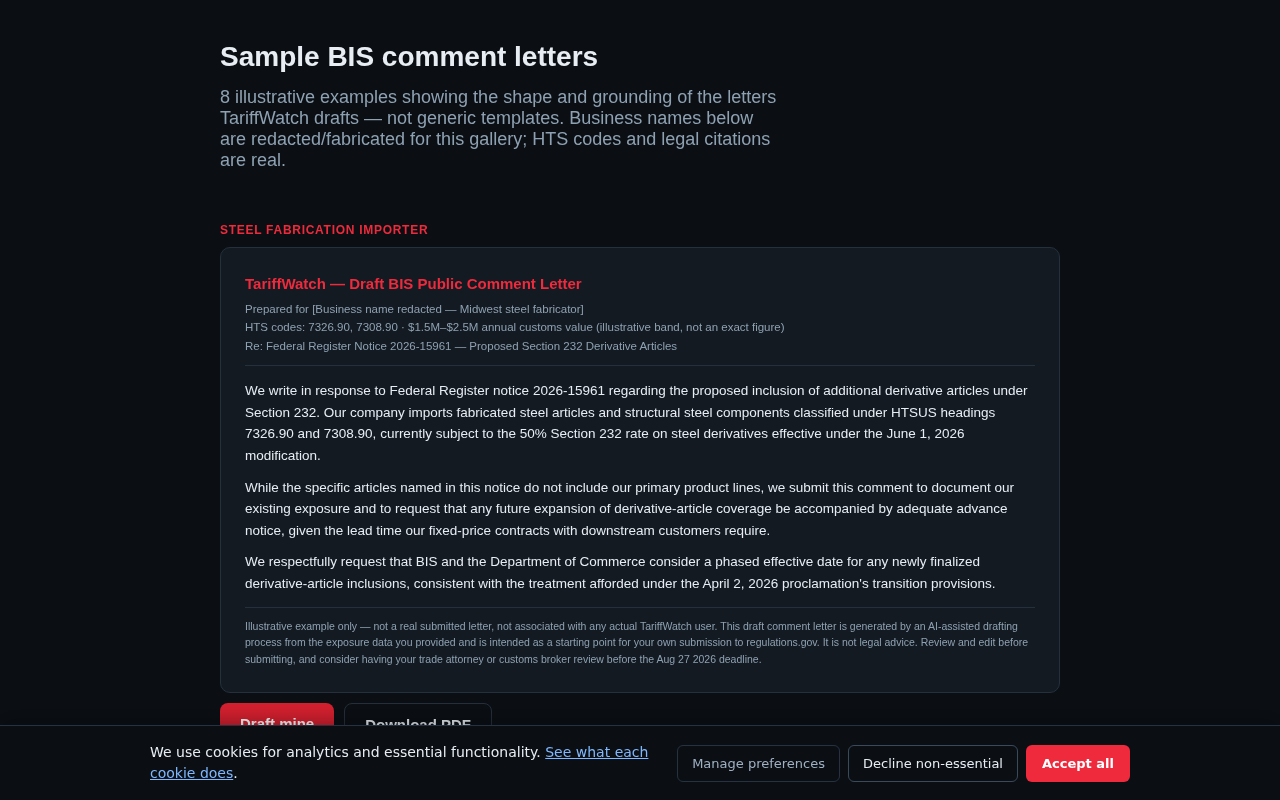
Key point: When Commerce and USTR seek comment first, as with BIS-14, the Federal Register proposal lists the specific HTS codes and proposed rates before anything becomes binding. The BIS-14 notice (2026-15961) listed all 14 proposed articles weeks before any final action.
A national-security tariff law from 1962 is quietly rewriting your landed cost — and the notices that decide whether your product is next are public, but almost nobody watches them.
The three-month call from your broker
Here's how it usually goes. You import a product — maybe it's a bracket, a fastener, an appliance part, a piece of outdoor furniture hardware. Steel or aluminum makes up something like 30% of its value. You've never thought about it as a "steel product." You think about it as a part number.
Then Commerce and USTR publish a Federal Register notice proposing to add your HTS code to Section 232 derivative coverage, under the authority Proclamation 11021 gives them. This isn't a rumor or a trade-press leak. It's a formal notice, posted publicly; this time, as with BIS-14, it asks for public comment first, although Proclamation 11021 does not require that.
Nobody tells you directly. Why would they? You're not named in the notice. You're just the importer whose landed cost is about to move.
Three months later your broker calls. Your HTS code got added. You now owe a 25% or 50% duty on the full customs value of every entry from the date the new Chapter 99 code took effect. Your margin on that SKU is gone, maybe underwater, and you're finding out about a decision that was published before it became binding.
This is the part almost no SMB importer understands about Section 232 in 2026: it is not a static tariff you check once and file away. Coverage can change whenever Commerce and USTR publish a new notice under Proclamation 11021, on no fixed schedule, and your exposure changes with it, whether you're watching or not.
This playbook is the watching part.
1. Section 232 in plain English
Section 232 of the Trade Expansion Act of 1962 (19 U.S.C. § 1862) lets the President restrict imports that the Secretary of Commerce determines threaten to impair national security. It's not a trade-remedy statute in the antidumping/countervailing-duty sense — it doesn't require proof of unfair pricing. It requires a national-security finding, an investigation run by the Commerce Department, and a presidential decision on remedy.
For decades this was a rarely-used tool. That changed in 2018. Commerce completed Section 232 investigations into steel and aluminum imports, and the President acted on them through two proclamations: Proclamation 9704 (aluminum) and Proclamation 9705 (steel), both issued in March 2018. Proclamation 9705 set a 25% tariff on covered steel articles. Proclamation 9704 set a 10% tariff on covered aluminum articles. Country exemptions and quota deals came and went over the following years — Canada, Mexico, the EU, the UK, South Korea, and others cycled through different arrangements at different points.
The rates did not stay put. Aluminum's rate was later raised from 10% toward parity with steel, and starting in 2025 both metals saw a further, larger escalation — reporting and BIS/Commerce actions through 2025 pushed the baseline rates for many countries up again, with steel and aluminum both cited at substantially higher levels than the original 2018 rates for most trading partners. Treat any specific percentage you read — including in this article — as a snapshot, not a fact you bank on. The rate that applies to your entry on the day it clears is the rate in the current proclamation and its Federal Register implementation, not the rate you remember from a headline. Before you quote a number to your CFO, pull it fresh from the Federal Register or BIS's Section 232 program page at bis.doc.gov.
What matters more than any single rate, for the purposes of this playbook, is the mechanism: Commerce/BIS administers the program, proclamations set and change rates and coverage, and — critically for SMB importers — the definition of what counts as a "covered" article has expanded far past raw steel and aluminum mill products. That expansion is the part most importers miss, and it's the subject of the next section.
2. Derivative articles — how the net got wider
The original 2018 proclamations covered steel and aluminum in mill forms — flat products, bars, pipes, extrusions, and the like. If you imported finished goods that merely contained steel or aluminum, you were outside the tariff. That distinction didn't last.
In January 2020, the administration expanded Section 232 to cover certain "derivative" articles — products one step downstream of raw metal, like certain nails, stranded wire, and specific steel and aluminum stampings used in vehicles. This was the first signal that the government was willing to reach past mill products into fabricated goods, using the theory that surging derivative imports were undermining the original tariffs' purpose by giving importers an end-run.
That 2020 expansion was narrow compared to what came next. In February 2025, BIS and the White House executed a much larger expansion of the derivative product lists — pulling in a long roster of downstream, fabricated products across categories including appliances, furniture components, structural building products, fasteners, and auto parts. This is the expansion that actually matters to most SMB importers reading this, because it's the one that turned "steel tariff" from a raw-materials issue into a finished-goods issue.
The mechanical detail that used to trip people up: before April 6, 2026, the duty on many derivative products was assessed only on the steel or aluminum content value, the portion of the product's value attributable to the metal in it. That is no longer the rule. Since April 6, 2026, Proclamation 11021 applies the Section 232 rate to the full customs value of a covered derivative article, at the rate of the annex that lists it (for example 50% for Annex I-A and 25% for Annex I-B). A steel garden shed now pays the 232 rate on its whole entered value, not on the steel share. The main relief left is narrow: an article whose covered metal is less than 15% of its weight can be exempt, but that exemption is not available for articles in HTS chapters 72, 73, 74 or 76. Section 6 below walks through the full-value math.
The list of covered derivative HTS codes is not fixed. It has been added to multiple times since 2018, and it can still be expanded, now through Commerce and USTR notices under Proclamation 11021 rather than the petition-driven inclusion process that ran from 2025 until April 6, 2026. Which brings us to the mechanism you actually need to understand.
3. How derivative coverage changes now
This is the section to bookmark.
From 2025 until April 6, 2026, BIS ran a formal inclusions process under Proclamations 10895 and 10896: petition windows roughly three times a year, in which domestic producers could ask BIS to add specific derivative HTS codes. That process no longer exists. Proclamation 11021 (effective April 6, 2026) terminated the derivative inclusion process that Proclamations 10895 and 10896 set up in February 2025, and those February 2025 proclamations had already ended the product-exclusion process. There are no petition windows or exclusion requests to file today; future derivative additions come through Commerce and USTR notices under Proclamation 11021, and the BIS-14 proposal (Federal Register 2026-15961, comment window closed Aug 27, 2026) is an example.
How the current route works:
- No petition windows. Nobody can petition to add a code on a set cycle anymore. Additions come through Commerce and USTR notices in the Federal Register.
- A comment period, when offered. Proclamation 11021 says Commerce and USTR *may* seek public comment, so a comment period is typical but not guaranteed. BIS-14 (FR 2026-15961, published Aug 6, 2026; docket BIS-2026-0331) had one, and it closed Aug 27, 2026.
- A final action. A final action sets the covered codes and rates (the BIS-14 proposal's rates are mixed: generally 25%, with cranes and lifting frames at the Proclamation 11032 mobile-equipment rates, agricultural trailers at 15%, and filled steel containers at 50% on the container value only). Until a final action is published, a proposal is not in effect.
- Effective dates. Under Proclamation 11021, an inclusion applies from the date of the finding or the first practicable date set in the Federal Register notice; confirm the effective date and any treatment of goods in transit in the specific notice rather than assuming it.
Why this matters more than the base tariff rate: the product list can change with little warning. A notice can add HTS codes for products that look nothing like "steel" or "aluminum" on your packing list. Your furniture-hardware supplier's product may not be covered today and could be proposed in the next notice. Nobody calls to warn you. The proposal, the comment window, and the final action are all public — but "public" and "on your radar" are different things unless you build a habit around it (Section 10 covers exactly how).
If you take one structural fact from this entire article, take this one: Section 232 exposure for a derivative-goods importer is not a status, it's a moving target that can move whenever a new notice is published, on no fixed schedule.
4. How to determine if your product is covered today
Before you can manage the moving target, you need to know where you stand right now.
Start with HTS Chapter 99. Section 232 duties are implemented through special Chapter 99 provisions layered on top of your product's normal HTS classification (Chapter 1–97). Until April 6, 2026, steel and aluminum 232 coverage was implemented through headings in the 9903.80 through 9903.85 range. Since April 6, 2026 (Proclamation 11021), Section 232 is reported under 9903.82.01 through 9903.82.26, with the default annex rates in 9903.82.02 through 9903.82.17 and 9903.82.20 through 9903.82.26 added on June 8, 2026 (Proclamation 11032, Annex IV; through Dec 31, 2027) for Annex I-C partner/USMCA rates and qualifying parts, for steel and for aluminum from other origins, while aluminum that is Russian, or smelted or cast in Russia, stays under 9903.85.67 (products) and 9903.85.68 (derivatives) at 200 percent under Proclamation 10522. The exact subheading assigned to your product changes as the lists get amended — don't memorize a number from a 2023 article (including, eventually, this one) and assume it still applies. Pull the current Chapter 99 text directly from hts.usitc.gov or your broker's classification software before you rely on it.
Read the annexes, not just the headline. BIS and CBP publish the derivative product annexes as long tables of specific 10-digit HTS numbers, sometimes with descriptive carve-outs (e.g., "except when imported as parts of X"). Your product may share a 6-digit heading with a covered item but sit on an uncovered 10-digit line, or vice versa. This is not a skim-the-summary exercise — someone needs to check your actual entered HTS numbers against the actual annex line items.
Ask your broker three specific questions, not one vague one. "Am I affected by steel tariffs?" gets you a shrug. Ask instead:
- "For HTS code [X], is there an active Chapter 99 steel/aluminum derivative overlay, and what's the current rate?"
- "Which Proclamation 11021/11032 annex lists my HTS code, and does any of my product qualify for the less-than-15%-by-weight metal exemption (not available for chapters 72, 73, 74 or 76)? If so, what weight documentation are you requesting from me?"
- "Is my HTS code named in any pending Commerce/USTR Section 232 proposal, such as the BIS-14 notice (2026-15961)?" (Most brokers will need to check this specifically — it's not part of routine classification work unless you ask.)
Check both directions. Don't just check whether you're currently covered — check whether a near-neighbor classification is covered or proposed. If a very similar product one HTS line over from yours was added or proposed recently, that's a signal your line is a plausible target for a future notice. This is where the exposure audit (further down) becomes a standing document instead of a one-time check.
5. Melt-and-pour and smelt-and-cast reporting
If your product is covered, expect a second compliance burden layered on top of the duty itself: country-of-origin reporting for the underlying metal, independent of where the finished product was manufactured or assembled.
Melt and pour (steel). For steel articles, CBP requires reporting of the country where the steel was melted and poured — meaning the country where the raw steel was first produced from iron ore or scrap in its initial solid steel form. This is not the same as "country of origin" for the finished product and not the same as where the product was fabricated, stamped, or assembled. A part stamped in Country A from steel coil melted and poured in Country B has two different country data points, and CBP wants the melt-and-pour one for 232 purposes.
Smelt and cast (aluminum). The aluminum equivalent requires reporting the country where the aluminum was smelted (primary aluminum production from alumina) and where it was most recently cast into the form used in your product. Aluminum supply chains are frequently multi-country — smelted in one country, cast in another — so both data points can matter.
What this means for your supplier relationships. You cannot get this data by guessing or by relying on "Made in [Country]" on a commercial invoice — that label typically reflects where the finished good was produced, not where the metal was melted/poured or smelted/cast. You need your supplier (or their mill) to provide melt-and-pour or smelt-and-cast certification, ideally per shipment or per lot, in a format your broker can attach to the entry. If your supplier can't produce this documentation, that's a real problem — not a paperwork nuisance, but a signal that either (a) they don't have visibility into their own upstream supply chain, or (b) the metal is coming from a country whose disclosure they'd rather you not see closely.
Start this conversation before you need it. The worst time to discover your supplier can't produce melt-and-pour documentation is the week your broker asks for it to clear an entry. Build it into your supplier onboarding and periodic requalification process now, for every supplier whose product touches steel or aluminum content — even ones not currently on a derivative list, because Section 3 already told you coverage can change with any new notice.
6. Calculating what you'll actually owe
Since April 6, 2026, the math has fewer moving pieces than it used to: total entered (customs) value and the rate of the annex that lists your HTS code. Before that date, many derivatives were assessed only on their steel/aluminum content value; that basis no longer applies. Here's a worked, illustrative example. Use your own verified current rate, not the number below, for real decisions.
Scenario: You import a steel-frame outdoor furniture set. Entered value: $40,000 per shipment (100 units at $400 landed cost each). Your broker confirms the HTS code is listed on Annex I-B.
| Step | Calculation | Result | |---|---|---| | Total entered value | 100 units × $400 | $40,000 | | Duty base | full customs value (since April 6, 2026) | $40,000 | | Metal-content exemption | steel is well over 15% of the article's weight | not available | | Illustrative 232 derivative rate (verify current annex before use) | applied to full customs value | e.g., 25% (Annex I-B) | | Section 232 duty owed | $40,000 × 0.25 | $10,000 | | Normal Ch. 1–97 duty (separate, still owed) | e.g., 3.4% of full $40,000 | $1,360 | | Total duty burden, this shipment | 232 duty + standard duty | $11,360 |
That $10,000 is money you were very possibly not pricing into this SKU six months ago, and it lands on top of — not instead of — your normal duty. If the same code were on Annex I-A at 50%, the 232 line would be $20,000. Under the pre-April-6, 2026 content-value basis, a 35% steel share would have put the base at only $14,000, which is why older cost models understate current exposure. It also, per Section 9, cannot be recovered through drawback even if the finished goods are re-exported.
The part importers get wrong most often: the annex and the weight test are not something you get to eyeball. Confirm which annex lists the exact HTS code, and if you claim the less-than-15%-by-weight exemption, you need it substantiated with a bill of materials, a supplier weight breakdown, or an engineering specification. CBP can and does request support for exemption claims, and "we estimated it" is not a great answer in a request-for-information letter. If your supplier won't give you a BOM-level breakdown, get your customs broker or a trade attorney to help you build a defensible methodology before you need it in an audit, not during one.
Run this table for every SKU you flagged in Section 4 as covered or borderline. If you don't know which annex lists each code today, that's the first gap to close — not after your next entry, before it.
7. The 30-day response cycle when a new proposal is published
Section 3 told you how additions happen now. Here's what to do when a new Commerce/USTR proposal is published, on a day-by-day basis. Comment periods vary (BIS-14's ran about three weeks), so adjust to the dates in the specific notice, which you should be tracking per Section 10.
Day 0 — a proposal publishes. Commerce and USTR publish a Federal Register notice proposing additional derivative articles. This is your trigger event. If you're not watching for it directly, your first signal will be a trade-press summary days later — don't rely on that as your primary source.
Days 1–3 — screen your HTS codes against the notice. Cross-reference the HTS codes and product descriptions in the notice against your own catalog and near-neighbor codes. This is a fast triage pass: is anything you import, or anything one line away from what you import, named in the proposal?
Days 4–14 — file a comment if your code is named. If the proposal names a code you rely on, the comment period is your window to oppose or shape it. See Section 8 for what actually moves the needle. Start building your data and argument the day you spot the notice, because comment periods are short relative to how long it takes to assemble supply-chain evidence.
Days 15–30 — scenario-plan pricing and sourcing regardless of outcome. Whether or not you commented, use this stretch to model what happens if the proposal is finalized: recalculate your full-value duty exposure (Section 6), identify whether alternate sourcing or product re-engineering (Section 9) is realistic before an effective date hits, and flag the SKU to whoever owns pricing so a duty increase doesn't surface as a surprise margin hit next quarter.
There is no fixed schedule for these notices, so a calendar reminder alone won't catch them. Use the Federal Register's own BIS email alerts, which arrive as notices publish, or a weekly watchlist digest — vague "check periodically" reminders are how importers end up hearing about coverage from their broker instead of from the Federal Register.
8. Commenting on a proposed derivative addition
Most SMB importers assume commenting is pointless — that these are foregone conclusions. Sometimes that's closer to true than anyone would like. But Section 232 additions are still built around a stated national-security rationale, and comments that engage with that rationale on the merits carry more weight than complaints about cost. (The BIS-14 comment window closed Aug 27, 2026; this section applies to future proposals.)
What tends to persuade, based on the stated criteria BIS and Commerce have used in Section 232 determinations generally:
- Domestic availability arguments. If the domestic industry cannot actually supply the specific derivative product at the volume, spec, or price the market needs, that's directly relevant to a national-security-based coverage decision — the theory of the whole program is protecting domestic capacity that matters to security, not domestic capacity in the abstract. Evidence: RFQs to domestic suppliers showing no bids, no capacity, or lead times incompatible with your industry's needs; documented quality or certification failures from domestic sourcing attempts.
- National-security nexus (or lack of one). Proposals are strongest when they can tie the product to a security-relevant supply chain. Comments are strongest when they can show the opposite — that a product (say, a decorative furniture bracket) has no plausible national-security dimension distinguishable from thousands of unrelated consumer goods.
- Import-surge data, examined honestly. If the proposal relies on a surge in imports of the derivative product displacing domestic production, real trade data (Census/USITC import statistics) either supports or undercuts that claim. Don't just assert it's wrong — bring the numbers.
- Downstream harm with specifics. Generic "this will hurt small business" comments get discounted. Comments with actual numbers — units affected, jobs at your specific facility, price increases you'll have to pass to specific customer segments — read as evidence, not lobbying.
What doesn't move the needle much: pure cost complaints without domestic-availability evidence, comments filed after the window closes, and comments that don't cite the specific HTS lines in the proposal.
Practically: if you're a solo SMB importer, you may not have the bandwidth to build a full comment on your own. This is where industry associations earn their dues — a trade association comment backed by member data carries more weight than one company's letter, and it's worth finding out now (not during a live comment period) whether your industry has one that tracks these notices.
9. Mitigation levers
If your product is covered — or about to be — here's what's actually available to you, and what isn't.
Sourcing shifts. Moving to a supplier whose steel or aluminum has different country-of-melt/pour or smelt/cast origin can matter if country-specific rates or quotas apply, but the base derivative-article duty generally applies regardless of country once a product is on the covered list (country distinctions matter more for the underlying metal tariffs and any negotiated country arrangements than for whether the finished derivative is covered at all). Verify current country-specific treatment before assuming a sourcing switch solves the problem — it may reduce your rate, or it may do nothing if the derivative coverage itself is country-agnostic.
Product re-engineering and reclassification. Because duty is now assessed on the full customs value, reducing the metal's share of value no longer lowers the duty base the way it did before April 6, 2026. What can still matter is a real design change that moves a product outside the covered derivative codes, or that brings the covered metal below 15% of the article's weight (an exemption not available for chapters 72, 73, 74 or 76). This has to be a real engineering and cost change, documented as such; cosmetic reclassification without an actual product change is the kind of thing that draws CBP scrutiny.
First-sale valuation. If your supply chain has a qualifying multi-tiered sale (factory → trading company → you), first-sale valuation can lower the customs value used as your duty base under the standard rules, and because the Section 232 rate now applies to that full customs value, a properly substantiated first-sale program lowers your 232 exposure too. This requires real documentation (arm's-length sales, no post-importation price adjustments back to the factory price) — it's a legitimate program, not a loophole, and it needs a broker or trade counsel who's built one before.
FTZ — manage expectations here. Foreign-Trade Zones do not let you dodge Section 232 duties on covered goods. Goods subject to Section 232 that are admitted into an FTZ are generally required to be admitted in privileged foreign status, which locks in the duty rate and classification as of the date of admission to the zone — you don't get the benefit of duty deferral turning into duty avoidance through zone processing. An FTZ can still help with cash-flow timing and logistics, but don't build a mitigation plan around FTZ status making the duty disappear.
No drawback. Duty drawback — the mechanism that lets importers recover duties paid on goods that are later exported or destroyed — is not available for Section 232 duties. This has been a consistent feature of the program since 2018 and it means the "we'll just re-export the excess inventory and claim it back" plan does not work here, unlike with many ordinary Chapter 1–97 duties.
The honest summary: there's no clean escape hatch. The real leverage is upstream — sourcing, engineering, and valuation — combined with early warning (Section 10) so you're making these changes on your own timeline instead of during a duty-shock scramble.
10. Building a standing monitoring habit
Everything above assumes you know when something changes. Here's how to actually know.
Federal Register alerts. Set up a saved search or email alert on federalregister.gov for Section 232 steel and aluminum notices. This is the primary-source publication point for proclamations and for Commerce/USTR proposals and final actions on derivative additions — not a summary written days later.
BIS's own Section 232 program page. bis.doc.gov maintains current program information, including derivative product lists. Check it on a schedule, not "when something feels off."
Broker SLAs, made explicit. Don't assume your customs broker is proactively watching this for you unless you've asked and gotten a yes in writing. Ask directly: "Will you notify me if a new Section 232 proposal or final action affects any HTS code I currently import, within how many business days?" Get that as an explicit service commitment, not an assumption baked into the relationship.
Why annual check-ins fail. If your compliance process is "we review our tariff exposure once a year," you will structurally miss this. Notices adding derivative articles arrive on no fixed schedule, so an annual review can find a list that has already changed, with effective dates and duty liability that may already be behind you. That gap is where the $10,000 surprise duty bill in Section 6 comes from.
The realistic target: a standing watchlist tied to your actual HTS codes, checked against every new Section 232 notice as it publishes — not a person's memory, not an annual calendar reminder, but a system that flags a match the day it becomes public. That's the only cadence that matches how the program actually moves in 2026.
The 232 Exposure Audit
A working checklist — run this now, then re-run it every time a new Section 232 proposal or final action is published.
- List every HTS code you currently import, including near-neighbor codes for products you're considering sourcing or reclassifying.
- Check each code against current Chapter 99 flags (9903.8x-range provisions) using hts.usitc.gov or your broker's live classification tool — not a saved list from a prior quarter.
- Confirm the annex and duty base for each covered or borderline SKU: the Section 232 rate applies to full customs value, and any less-than-15%-by-weight exemption claim (not available for chapters 72, 73, 74 or 76) needs a supplier weight breakdown, not a guess.
- Get melt-and-pour (steel) or smelt-and-cast (aluminum) documentation from every supplier whose product contains meaningful steel or aluminum content, before you need it for an entry.
- Set a Federal Register alert for new Section 232 derivative notices, since there is no fixed schedule to calendar.
- Assign an owner — one named person responsible for checking new Federal Register notices the day they publish and running the Day 0–30 cycle in Section 7. "Someone should watch this" is not an assignment.
Run steps 1–4 today if you haven't. Steps 5–6 are what keep this from becoming a one-time exercise you forget about until the next surprise duty bill.
FAQ
Is there still a product exclusion process for Section 232? No. BIS ran a formal exclusion-request process from 2018, later supplemented by General Approved Exclusions, but Proclamations 10895 and 10896 ended the product-exclusion process in February 2025, and Proclamation 11021 terminated the derivative inclusion process they created as of April 6, 2026. The relief left is narrow: articles whose covered metal is less than 15% of their weight (not available for chapters 72, 73, 74 or 76), annex placement, and any country-specific rates in the current proclamations. Confirm treatment for your exact HTS code with your broker.
Do Section 232 duties stack with Section 301 duties? Yes, generally. Section 232 (national security) and Section 301 (unfair trade practices, primarily China-focused) are separate legal authorities, and where a product is covered by both, the duties are typically layered on top of each other and on top of your normal Chapter 1–97 duty rate. There's no automatic offset between them. If you import steel or aluminum derivative goods from China, check your exposure under both programs — not just one.
Can I get duty drawback on Section 232 duties? No. Drawback recovery has not been available for Section 232 duties since the program began in 2018, and that hasn't changed with the derivative expansions. If your mitigation plan relies on exporting or destroying excess inventory to claim duties back, that plan doesn't work for the 232 portion of your duty bill — plan your inventory and sourcing decisions accordingly.
What is "melt and pour"? It's the country where raw steel was first produced in solid form — from iron ore or scrap, at the mill — as distinct from where a finished product was stamped, assembled, or shipped from. CBP requires this data point reported on covered steel entries because a product can be "made in" one country while its underlying steel was melted and poured in a completely different one, and 232 treatment can turn on that upstream fact.
What's the aluminum equivalent of melt and pour? Smelt and cast — the country where primary aluminum was smelted from alumina, and the country where it was most recently cast into the form used in your product. Aluminum supply chains frequently split these two steps across different countries, so both need documentation.
How do I know if my HTS code is on a "derivative" list right now? Check the current Chapter 99 provisions tied to your specific 10-digit HTS number at hts.usitc.gov, and ask your broker directly whether an active steel/aluminum derivative overlay applies to it. Don't rely on a general sense of "my product isn't really a steel product" — many currently-covered derivative articles (furniture hardware, fasteners, appliance parts) don't look like steel products to a layperson either.
If my product isn't covered today, can I assume it's safe? No. That's the central point of this article. Coverage can expand whenever Commerce and USTR publish a new notice under Proclamation 11021, on no fixed schedule, so "not covered today" only tells you about today. The only real protection is watching for new notices, not a one-time classification check.
How is the duty actually calculated on a derivative article — full value or content value? Since April 6, 2026, on the full customs value, at the rate of the Proclamation 11021/11032 annex that lists the HTS code (see the worked example in Section 6). The older content-value basis, where many derivatives paid only on their steel or aluminum content, applied before April 6, 2026 and is no longer current. The main remaining carve-out is the exemption for articles whose covered metal is less than 15% of their weight, which is not available for chapters 72, 73, 74 or 76.
Can product re-engineering actually reduce my duty? Sometimes. Because the duty is now assessed on full customs value, lowering the metal's share of value no longer shrinks the duty base the way it did before April 6, 2026. A genuine, documented design change can still help if it moves the product outside the covered derivative codes or brings the covered metal below 15% of the article's weight (not available for chapters 72, 73, 74 or 76). It's not a paperwork trick — CBP can and does scrutinize reclassification without substance.
Who proposes new derivative additions now, and how do I find out? Since April 6, 2026, there is no petition process: Proclamation 11021 terminated the 10895/10896 inclusion process, and additions come through Commerce and USTR notices published in the Federal Register (BIS-14, whose comment window closed Aug 27, 2026, is an example). When Commerce and USTR ask for comment first, as they did with BIS-14, the notice is public before anything is binding, which is exactly why Section 7's Day 1–3 triage matters; a comment period is not guaranteed, so watch for final notices too.
Primary sources
- 19 U.S.C. § 1862 (Section 232) — statutory authority.
- Commerce steel tariff information (trade.gov) — program background; the Section 232 exclusion process ended in February 2025.